
Why Interest in Balkan Real Estate Is Growing
Tourism growth, infrastructure investment, European integration, and wider international visibility are changing how buyers and investors view real estate across the Balkans.
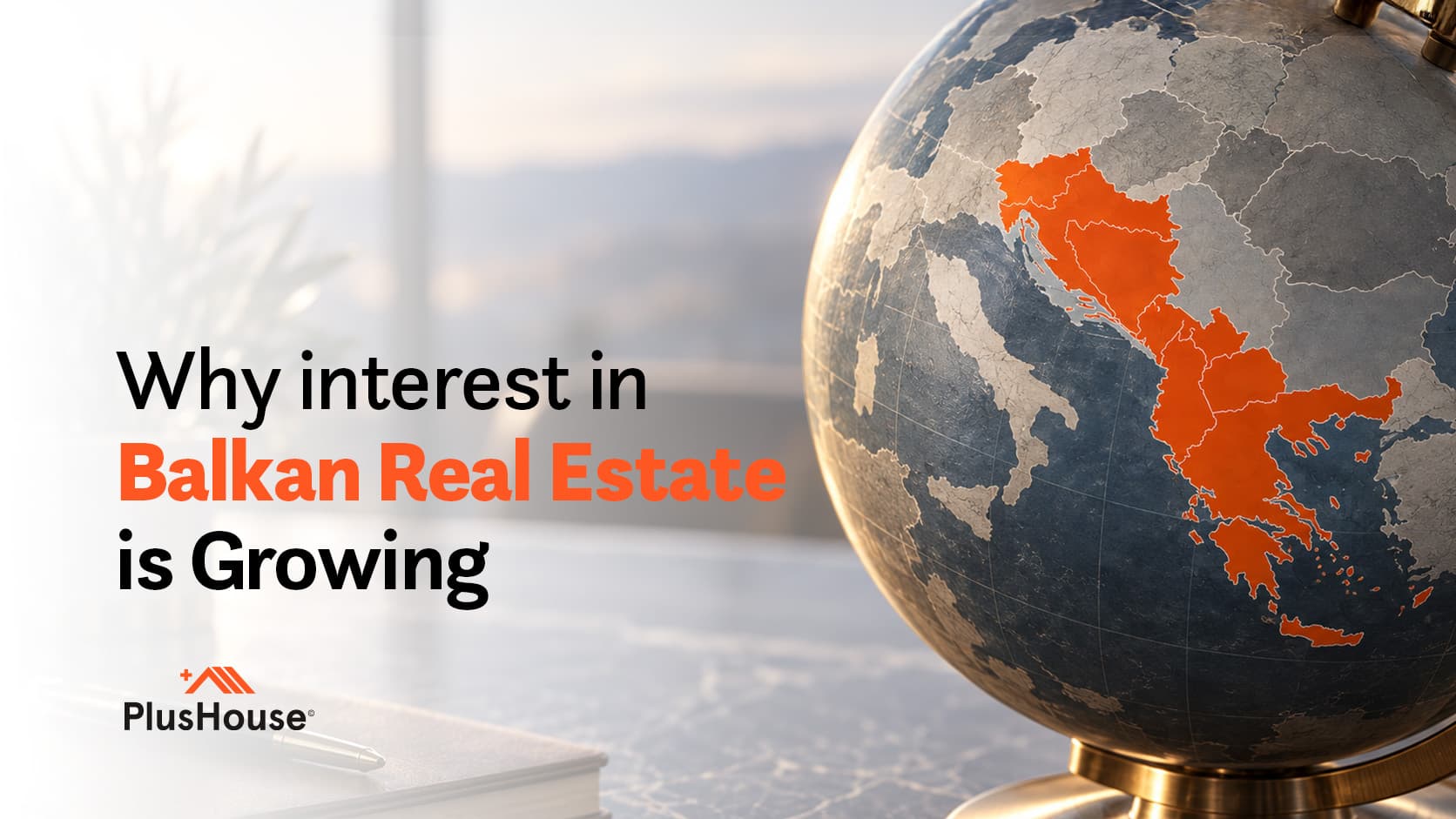
From fast-growing cities to the shores of the Adriatic and Ionian Seas, the Balkans are attracting a broader audience of buyers and investors. Yet the region is not a single real estate market.
For many international visitors, the Balkans were long associated primarily with tourism. Today, cities are expanding, regional connections are improving, and digital platforms make it easier to explore properties across borders. Buyers are considering homes in capitals and secondary cities, coastal residences, seasonal properties, and new developments in destinations that have only recently gained international attention.

One Region, Many Realities
The Balkans bring together EU member states and countries at different stages of economic development and European integration. These differences are reflected in legal frameworks, purchasing procedures, urban planning, construction activity, and market transparency.
Even within the same country, a capital city does not operate like a coastal area. A destination shaped by seasonal tourism operates differently from a city where residential demand is supported by employment and economic activity.
The term “Balkan real estate market” is therefore only a starting point. Each opportunity must be assessed according to its country, city, location, and property characteristics.
→ The Balkans are geographically connected, but they are made up of distinct markets. This diversity creates opportunity—and requires local analysis.
Tourism Is Opening the Door to Local Property Markets
For many international buyers, their introduction to the Balkans begins with travel. A visit to the coasts of Albania, Montenegro, or Croatia, a historic city, or a mountain destination can change how a place is perceived.
Familiarity with the lifestyle, services, transport connections, and everyday costs can gradually lead to interest in a second home, a longer stay, relocation, or investment.
Albania offers a clear example of the region’s growing tourism visibility. According to UN Tourism, the country recorded 56% more international tourist arrivals in 2023 than in 2019, placing it fourth worldwide for growth over this period.[1]
However, a successful tourism season does not automatically create sustainable property demand. Its impact depends on the location, accessibility, infrastructure, seasonality, and local economy.
→ Tourism can place a Balkan destination on the map. The local market determines whether that interest can endure.
Infrastructure Is Connecting Regional Property Markets
For a region divided by borders and challenging terrain, infrastructure is particularly important. Roads, airports, ports, railways, and digital connections are improving movement between cities, countries, and tourism destinations.
The EU’s Reform and Growth Facility provides €6 billion for the Western Balkans for 2024–2027. At least half is intended for priority infrastructure investments supported through the Western Balkans Investment Framework.[2]
The effect on property markets depends on project delivery, timelines, the connections created, and the existing demand in each area.
→ Infrastructure can expand an area’s potential, but project delivery and existing demand determine its property-market impact.
Price and Value Are Not the Same
Interest in the Balkans is often linked to the perception that some markets offer more accessible entry prices than established European destinations. But a lower-priced property does not necessarily represent better value.
A property with a low price may require renovation, have limited access, unclear documentation, or be located in a market with weak demand. A higher price may be justified by the location, construction quality, legal status, and established demand.
Comparisons should be made between similar properties and should clarify whether the price includes the internal floor area, the land, or both. Documentation and the property’s technical condition should be verified before a decision is made.
→ Price shows what a property costs. Local context reveals the value it represents.
European Integration Is Reshaping Expectations
The European Commission’s Growth Plan aims to give the Western Balkans earlier access to some of the benefits of EU integration, strengthen regional economic cooperation, and accelerate reforms.[3]
For property markets, alignment with European standards may support digitalisation, urban planning, administrative capacity, and transparency. However, progress varies from one country to another, and integration does not guarantee an increase in property values.
→ European integration may support stronger standards across Balkan property markets. Opportunities still depend on concrete developments in each country.
The PlusHouse Perspective
As the Balkans attract greater attention, searching for properties across borders requires better organisation, clearer information, and access to local expertise.
PlusHouse brings properties and professional agencies from different markets across the region onto one platform. Buyers can explore opportunities in multiple countries and connect directly with the agencies that represent those properties and understand their respective markets.
The goal is not to present the Balkans as one uniform market, but to create a regional network in which each market retains its own identity.
The future of Balkan real estate will depend on more than the number of properties published online. Buyers also need reliable information, meaningful comparisons, and access to qualified local professionals.
“The Balkans are gaining international attention. The challenge now is to turn that interest into better-informed decisions through clear information and local expertise.”
References
1 UN Tourism. (2024). Tourism Doing Business: Investing in Albania. View source
2 Western Balkans Investment Framework. EU Growth Plan for the Western Balkans. View source
3 European Commission. Growth Plan for the Western Balkans. View source